DEWA Tariff Structure 2024: How Slab Rates Affect Your Monthly Costs

Sarah Mitchell
14 April 2026
DEWA Tariff Structure 2024: How Slab Rates Affect Your Monthly Costs
Introduction
Navigating your monthly electricity and water bills in Dubai can feel overwhelming, especially when you notice significant fluctuations in costs despite similar usage patterns. The Dubai Electricity and Water Authority (DEWA) employs a sophisticated tiered pricing system that directly impacts your wallet, and understanding this structure is the key to taking control of your utility expenses.
DEWA’s slab-based tariff system isn’t just about paying for what you use – it’s a progressive pricing model designed to encourage conservation while ensuring fair distribution of utility costs across different consumer segments. Whether you’re a new Dubai resident or a long-time homeowner looking to optimize your monthly expenses, mastering the intricacies of DEWA’s 2024 tariff structure can lead to substantial savings throughout the year.
The difference between staying within lower-cost tiers versus exceeding them can mean hundreds of dirhams in additional monthly charges. This comprehensive guide will demystify DEWA’s pricing methodology and equip you with actionable strategies to minimize your utility costs.
Understanding DEWA’s Tiered Pricing System
How Slab Rates Work
DEWA’s tariff structure operates on a progressive slab system, where different consumption levels are charged at varying rates. Think of it as a staircase – the more you consume, the higher you climb, and each step costs progressively more per unit.
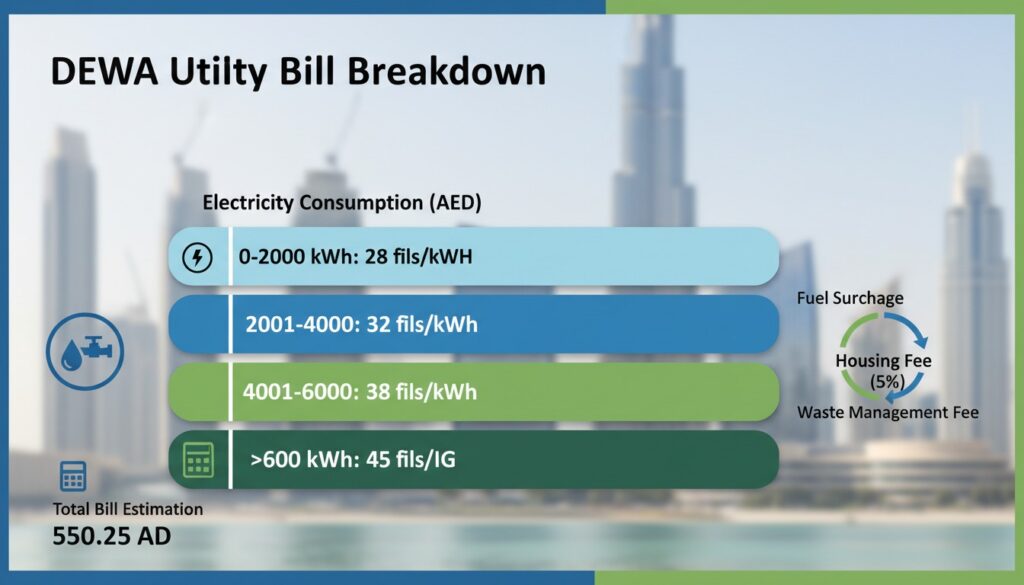
For residential customers in 2024, the electricity tariff structure includes:
- Slab 1 (0-2,000 kWh): 23 fils per kWh
- Slab 2 (2,001-4,000 kWh): 28 fils per kWh
- Slab 3 (4,001-6,000 kWh): 32 fils per kWh
- Slab 4 (Above 6,000 kWh): 38 fils per kWh
- Slab 1 (0-5,000 gallons): 3.5 fils per gallon
- Slab 2 (5,001-10,000 gallons): 4 fils per gallon
- Slab 3 (Above 10,000 gallons): 4.5 fils per gallon
- Housing Fee: 5% of electricity charges
- Municipality Fee: 5% of total bill
- Knowledge Fund: 1% of total bill
- Fuel Surcharge: Variable based on global fuel prices
- Water Resource Fee: Applied to water consumption
- 1,500 kWh × 23 fils = 345 AED
- Housing Fee (5%): 17.25 AED
- Subtotal: 362.25 AED
- Municipality Fee (5%): ~18 AED
- Knowledge Fund (1%): ~3.6 AED
- Total Monthly Bill: ~384 AED
- First 2,000 kWh × 23 fils = 460 AED
- Next 2,000 kWh × 28 fils = 560 AED
- Remaining 1,500 kWh × 32 fils = 480 AED
- Subtotal: 1,500 AED
- Housing Fee (5%): 75 AED
- Electricity Total: 1,575 AED
- Municipality Fee and Knowledge Fund: ~95 AED
- Total Monthly Bill: ~1,670 AED
- Pre-cooling Strategy: Cool your home during off-peak hours when possible
- Temperature Management: Maintain AC at 24°C instead of 20°C to reduce consumption by up to 20%
- Zonal Cooling: Only cool occupied areas of your home
- LED Lighting: Uses 75% less energy than traditional incandescent bulbs
- Energy Star Appliances: Can reduce consumption by 10-15%
- Smart Thermostats: Optimize cooling schedules automatically
- High-Efficiency AC Units: Look for units with high SEER ratings
- Low-flow fixtures: Reduce water usage without compromising functionality
- Leak detection: Regular maintenance prevents wasteful consumption
- Greywater systems: Reuse water for irrigation where permitted
- Smart irrigation: Use drip systems and moisture sensors for gardens
- Real-time monitoring: Track daily consumption patterns
- Usage alerts: Set notifications when approaching slab thresholds
- Historical analysis: Compare monthly and yearly consumption trends
- Bill predictions: Estimate upcoming charges based on current usage
- Smart meters: Provide detailed consumption breakdowns
- Automated scheduling: Control appliances during optimal times
- Load balancing: Distribute energy usage throughout the day
- Remote monitoring: Adjust consumption even when away from home
- Calculate your threshold: Determine your target maximum consumption
- Weekly monitoring: Track progress weekly to avoid month-end surprises
- Adjustment strategies: Have backup plans when approaching limits
- Family involvement: Ensure all household members understand conservation goals
- Insulation upgrades: Improve your home’s thermal envelope
- Window treatments: Use reflective films and blackout curtains
- Ventilation optimization: Ensure proper airflow throughout your home
- Time-shifting activities: Use heat-generating appliances during cooler hours
- Clothing adjustments: Dress appropriately for slightly higher indoor temperatures
- Activity planning: Schedule outdoor activities during cooler parts of the day
- Natural ventilation: Use outdoor air for cooling when possible
- Reduced AC usage: Take advantage of pleasant weather conditions
- System maintenance: Perform AC servicing during low-usage periods
- Historical analysis: Review past 12 months of bills
- Seasonal adjustments: Account for summer spikes and winter savings
- Improvement investments: Budget for energy-efficient upgrades
- Emergency reserves: Set aside funds for unexpected consumption increases
- Standby power: Electronics consume power even when “off”
- Water heating: Often accounts for 15-20% of electricity usage
- Pool pumps: Can significantly impact consumption in villa properties
- Outdoor lighting: Security and landscape lighting adds up quickly
- End-of-month panic: Start monitoring early in the billing cycle
- Seasonal unpreparedness: Begin summer preparations in May
- Appliance timing: Avoid running multiple high-consumption appliances simultaneously
- Solar panel integration: DEWA’s Shams Dubai initiative offers net metering
- Battery storage systems: Store energy for peak-demand periods
- AI-powered optimization: Smart systems that learn and adapt to your patterns
- Next-generation appliances: Continuously improving efficiency standards
- Annual reviews: DEWA periodically adjusts tariff structures
- Subsidy changes: Government policies may affect pricing
- New fee introductions: Stay informed about additional charges
- Conservation incentives: Watch for rebate and reward programs
- Monitor consumption weekly using DEWA’s smart app
- Invest in energy-efficient appliances to stay within lower slabs
- Implement seasonal strategies to manage summer consumption spikes
- Set realistic targets based on your household’s needs and budget
- Stay informed about tariff changes and new conservation technologies
- Download the DEWA Smart App and set up consumption alerts for your target slab
- Conduct a home energy audit to identify your biggest consumption sources
- Set monthly consumption targets based on your budget and the slab thresholds
- Schedule AC maintenance to ensure optimal efficiency during peak seasons
- Research energy-efficient appliance upgrades that fit your budget
Water Consumption Tiers
Water charges follow a similar progressive structure:
Pro Tip: Your bill calculation uses cumulative pricing, meaning you pay the lower rate for initial consumption and higher rates only for excess usage within each slab.
Additional Charges and Fees
Beyond consumption charges, DEWA bills include:
Calculating Your Monthly Costs: Real Examples
Low Consumption Household (1,500 kWh)
Let’s examine a typical one-bedroom apartment’s monthly bill:
Electricity Calculation:
Additional Fees:
High Consumption Household (5,500 kWh)
For a larger villa with higher consumption:
Electricity Calculation:
With Additional Fees:
Notice how the second household pays more than four times the first household’s bill, despite using less than four times the electricity.
Strategic Consumption Management
Peak Season Planning
Dubai’s extreme summer months (June-September) typically see consumption spike due to air conditioning demands. Strategic planning during these months is crucial:
Energy-Efficient Appliance Upgrades
Investing in energy-efficient appliances can keep you within lower slabs:
Water Conservation Techniques
Staying within lower water consumption slabs:
Monitoring and Optimization Tools
DEWA Smart App Features
DEWA’s mobile application provides powerful tools for consumption management:
Smart Home Integration
Modern smart home systems can automatically optimize consumption:
Setting Consumption Targets
Establish monthly targets based on your desired slab:
Seasonal Strategies and Long-term Planning
Summer Survival Techniques
During Dubai’s hottest months, implement these strategies:
Building Efficiency:
Behavioral Adaptations:
Winter Optimization
Dubai’s mild winters offer opportunities to reduce overall consumption:
Annual Budget Planning
Create a comprehensive yearly utility budget:
Common Mistakes and How to Avoid Them
Misconceptions About Slab Pricing
Myth: “If I exceed a slab, my entire bill is charged at the higher rate.”
Reality: Only the excess consumption is charged at higher rates.
Myth: “Small changes in usage don’t matter.”
Reality: Small reductions can prevent costly slab escalations.
Overlooked Consumption Sources
Many residents underestimate these consumption contributors:
Timing Mistakes
Avoid these common timing errors:
Future-Proofing Your Utility Strategy
Emerging Technologies
Stay informed about new technologies that can reduce consumption:
Regulatory Changes
Keep track of potential tariff adjustments:
Conclusion
Mastering DEWA’s 2024 tariff structure isn’t just about understanding numbers – it’s about developing a comprehensive approach to utility management that can save you significant money throughout the year. The progressive slab system rewards conservation and penalizes excessive consumption, making strategic planning essential for budget-conscious residents.
Key takeaways for immediate implementation:
Your utility bill is one of the few monthly expenses where you have direct control over the amount. By understanding and strategically working within DEWA’s tariff structure, you’re not just saving money – you’re contributing to Dubai’s sustainability goals and developing valuable energy management skills that will serve you well into the future.
Take Action Today
Start optimizing your DEWA bills immediately with these actionable steps:
Have questions about your specific consumption patterns or need personalized advice? Consider consulting with energy efficiency professionals who can provide tailored recommendations for your property type and usage patterns.